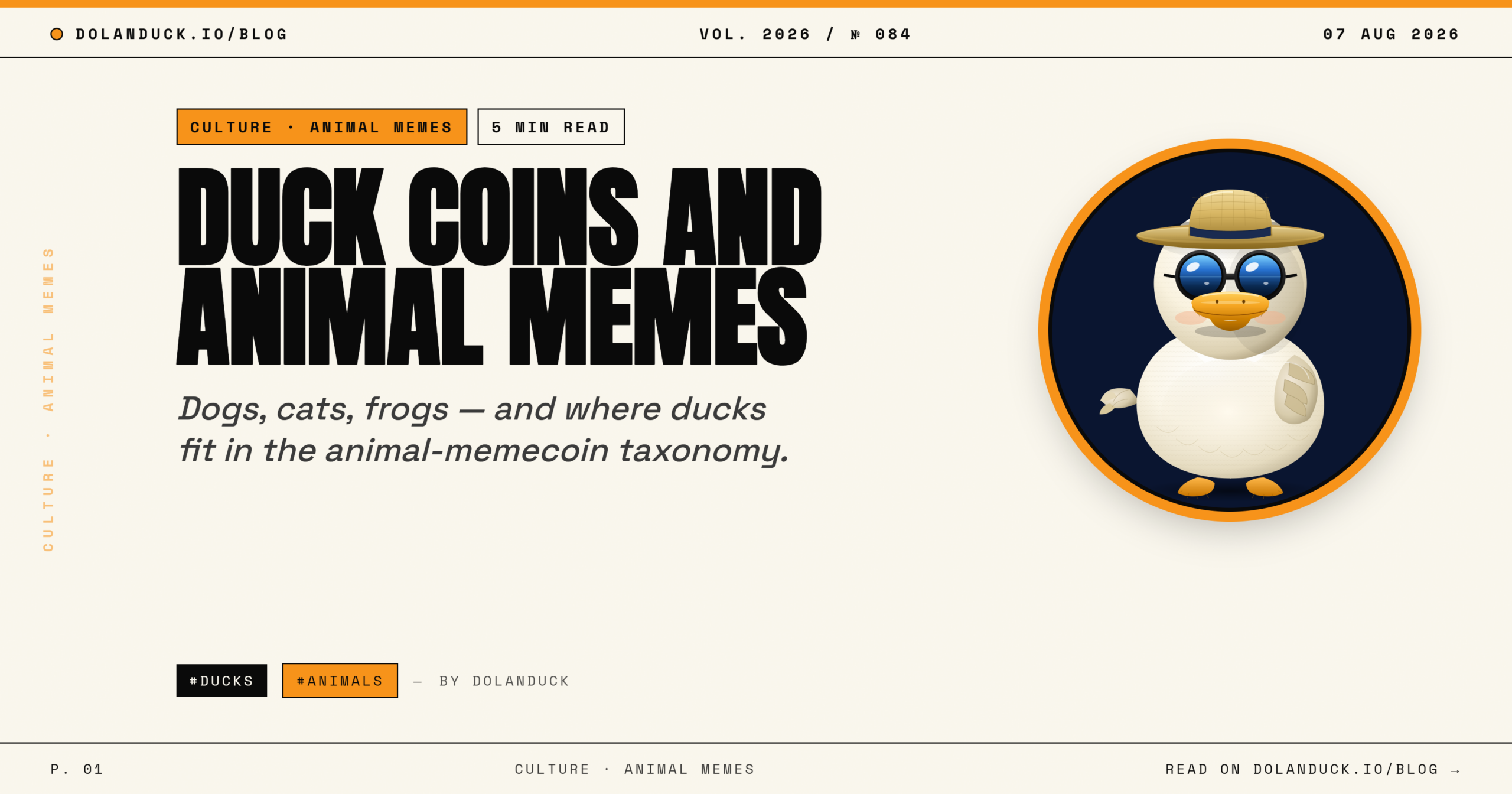
Animal meme coins are tokens built around a recognisable animal mascot rather than a product, and they are the single most repeated pattern in crypto market history. Every cycle since 2013 has produced one dominant animal — a shiba inu, then another shiba inu, then a dog in a hat, then a penguin — and in 2026 the rotation has moved toward ducks. The mascot is not decoration. It is the distribution mechanism, and the reason a token with no roadmap can hold a $10B market cap for thirteen years while better-funded projects disappear.
Key Facts
- Dogecoin launched in December 2013 and still carries a market cap near $10.9B as of August 6, 2026 — larger than every other animal token combined.
- Shiba Inu turned six years old in August 2026 and sits around $2.87B, roughly 26% of DOGE’s size.
- The 2023–24 Solana animal wave has compressed hard: BONK near $245M, dogwifhat near $138M.
- Pudgy Penguins (PENGU) is the largest non-canine animal token at roughly $387M, ranked around #85 by market cap.
- Cat mascots peaked and faded fastest — POPCAT is about 97.9% below its $2.05 all-time high, and MEW trades near $32M after crossing $900M within days of its March 2024 debut.
- Only 2 of 7 major animal tokens have held above $1B through the 2026 drawdown, both of them dogs launched before 2021.
Why Animals Beat Every Other Meme Category
An animal face survives translation. A political meme, an inside joke or a cultural reference needs shared context to land; a confused-looking dog does not. That single property explains why animal tokens cross language borders faster than anything else in crypto — a Korean, Brazilian or Turkish trader reads the same picture identically, no caption required. Every other meme category has to be explained before it can be bought, and explanation is friction.
The second advantage is the joke’s entry cost. Participating in an animal meme requires nothing beyond changing an avatar — no lore to study, no risk of using the format wrong in public. Compare that to any narrative token where holders are expected to argue technical claims; the social burden caps how fast a community grows. Animal communities scale because membership is free and instantly visible. Our general breakdown of how memecoins work covers the mechanics underneath the mascot.
Third: animals come with a ready-made visual kit. One source image generates thousands of derivatives — hats, crossovers, reaction crops — without anyone commissioning art. That derivative supply keeps a timeline warm between price moves, which is why a mascot with strong visual grammar outlives one with a static logo.
One Mascot Per Cycle: 2013 to 2026
The rotation is remarkably consistent. 2013 gave crypto Dogecoin, built on the Kabosu shiba image. 2020–21 produced Shiba Inu, which took the same animal onto Ethereum and proved a mascot could be re-used rather than invented. 2022–24 was Solana’s turn: BONK arrived on Christmas Day 2022 as an airdrop into a post-FTX wasteland, and dogwifhat followed in late 2023 with the purest version of the format — a dog, a hat, no further explanation. The full arc of that first Solana dog is covered in the story behind the Bonk mascot.
What broke the pattern was 2024’s cat season. POPCAT and MEW proved non-dog animals could run, and MEW’s push past $900M within days of launch ended the dog monopoly. Pudgy Penguins then did what none of the earlier tokens managed — it attached a token to an existing NFT brand with real merchandise distribution, which is why PENGU still outweighs both cats and both Solana dogs in August 2026.
| Ticker | Animal | Network | Launch | Market cap (Aug 6, 2026) |
|---|---|---|---|---|
| DOGE | Shiba inu dog | Dogecoin (own chain) | 2013 | ~$10.9B |
| SHIB | Shiba inu dog | Ethereum | 2020 | ~$2.87B |
| PENGU | Penguin | Solana / Ethereum | 2024 | ~$387M |
| BONK | Dog | Solana | 2022 | ~$245M |
| WIF | Dog in a hat | Solana | 2023 | ~$138M |
| POPCAT | Cat | Solana | 2023 | ~$43M |
| MEW | Cat | Solana | 2024 | ~$32M |
Read the table by age rather than size and the pattern is obvious: both billion-dollar survivors are dogs from before 2021, and everything launched after 2022 trades in the low hundreds of millions or below. Live figures for every ticker are published on CoinGecko, with pool-level liquidity on DEXScreener.
Ducks vs Dogs: A Different Meme Grammar
Dog memes run on sincerity. Doge, Cheems and the wif dog are all variations of earnest incompetence — the animal is trying its best, and the humour comes from affection. That grammar built enormous, warm communities, but it also has a ceiling: sincerity gets stale, and by the fourth dog token the format reads as a copy rather than a joke.
Ducks operate on the opposite register. Duck memes are absurdist, badly drawn on purpose, and slightly hostile — the humour comes from the crudeness itself, not from warmth. That makes duck imagery cheaper to remix and harder to exhaust, because a deliberately ugly drawing cannot be devalued by more ugly drawings. It also gives duck tokens distance from the dog category, which matters in 2026 when “another dog coin” reads as a liability. The trade-off is emotional range: ducks do not generate the mass sentimentality that carried DOGE for thirteen years, so a duck mascot competes on staying weird rather than on being loved.
Does the Mascot Actually Keep a Token Alive?
Partially, and the failure cases are instructive. A mascot buys attention at launch, but survival past the first 90% drawdown depends on whether the image existed before the token. DOGE, SHIB and BONK all borrowed memes already circulating independently, so the meme keeps living when the chart does not — and a living meme can pull a chart back. POPCAT’s 97.9% fall from $2.05 shows the other side: real meme, no distribution beyond it.
The second factor is mechanics people can verify. Holder counts, supply schedules and treasury behaviour decide whether a community stays after the joke gets old — BONK’s 2026 governance attack, which drained roughly $20M from the DAO treasury, hurt it more than any price move. Mascot pulls people in; verifiable supply keeps them.
Where DOLAN Duck Fits in the 2026 Duck Wave
DOLAN Duck ($DOLAN) is the duck-cycle entry that sits at the strict end of the mechanics test above. It runs as an SPL token on Solana at contract 4YK1njyeCkBuXG6phNtidJWKCbBhB659iwGkUJx98P5Z, launched fair with no team allocation and no private round, and carries a fixed total supply of 98.3M across roughly 10,697 holders. That supply figure is what to notice next to the table above: BONK spent three years burning tokens to make a quadrillion legible, while 98.3M is readable at a glance — price times supply, no zero-counting. The duck mascot handles the recognition problem every animal token must solve; the supply design handles the part that killed the cats. Where it ranks against the rest of the Solana animal field is tracked in our roundup of the leading Solana meme tokens.
Animal meme coins are cryptocurrencies whose entire identity is built around an animal mascot rather than a product or protocol. Dogecoin, Shiba Inu, BONK, dogwifhat, Pudgy Penguins, POPCAT and MEW are the main examples, and together they account for the majority of all memecoin market value.
An animal face needs no translation, so it spreads across language borders with zero explanation. Joining the joke costs nothing beyond an avatar change, and one source image generates endless derivative art for free. No other meme category has all three properties.
Dogecoin, at roughly $10.9B as of August 6, 2026. Shiba Inu is second near $2.87B, and Pudgy Penguins leads the non-dog animals at about $387M.
Dog memes run on sincerity and affection, which builds warm communities but wears out after repetition. Duck memes are absurdist and deliberately crude, which makes them cheaper to remix and harder to exhaust, but they generate less mass sentiment than dogs do.
Cat tokens ran hard in 2024 — MEW crossed $900M within days of its March 2024 launch — but neither major cat held up. POPCAT trades about 97.9% below its $2.05 all-time high and MEW sits near $32M as of August 6, 2026.
It helps at launch but does not guarantee survival. Tokens whose meme existed independently before the token — DOGE, SHIB, BONK — recover better, because the image keeps circulating even when the chart does not. Beyond that, verifiable supply and treasury behaviour matter more than the mascot.
$DOLAN is the duck-mascot entry of the current cycle: a Solana SPL token, fair launched with no team allocation, fixed 98.3M supply and around 10,697 holders. The small readable supply is the main structural difference from the trillion-supply dog coins that came before it.