CASHCAT is the first breakout memecoin on Robinhood Chain, a cat-themed ERC-20 token that turned Robinhood’s pre-launch internal codename into tradable lore and peaked above a $200M market cap on July 11, 2026 — ten days after the chain’s mainnet went live. With a fixed 1B supply, zero taxes, burned liquidity, and no official Robinhood affiliation, CASHCAT is textbook meme engineering: a true story, clean tokenomics, and perfect timing on a chain starving for its first hit.
Read moreMemecoins
Robinhood Chain vs Solana: A New Memecoin Threat in 2026?
Robinhood Chain memecoins went from non-existent to a $120M+ phenomenon in one week: the Ethereum Layer-2 launched its public mainnet on July 1, 2026, pitched as infrastructure for tokenized stocks — and by July 8 its first breakout meme token, CASHCAT, had surged over 1,700% in 24 hours while Robinhood’s CEO publicly warmed to meme trading on his own chain. For Solana, which has owned memecoin culture since 2023, this is the first credible attention raid in years, landing at the worst possible moment of its own drawdown. Whether it is a threat or a blip depends on what you think memecoin ecosystems actually run on.
Read more
Milady Meme Coin (LADYS) Explained: NFT Cult Token in 2026
Milady meme coin (LADYS) is an ERC-20 token on Ethereum launched in May 2023 as an unofficial tribute to Milady Maker, the 10,000-piece NFT collection created by the Remilia art collective. The token embodies memecoin design at its purest: no utility, no team allocation, no roadmap, no whitepaper — its entire price history is a chart of internet attention, peaking when Elon Musk posted a Milady image in May 2023 and fading roughly 99.8% from that all-time high by 2026. LADYS matters less as an investment than as a case study: it is the cleanest example of an NFT subculture converting itself into a tradeable ticker.
Read more
Where to Buy Solana Meme Coins in 2026: Top 5 Platforms
Where to buy Solana meme coins depends on the token’s age: brand-new launches trade on bonding-curve launchpads like Pump.fun, graduated tokens trade through DEX aggregators like Jupiter or directly on Raydium pools, and only a handful of majors (BONK, WIF, PENGU) ever reach centralized exchanges. In 2026 the practical default is a self-custody wallet plus Jupiter — it routes your order across every Solana DEX for the best price and covers 99% of tradeable memecoins. Total setup time from nothing to first trade: about five minutes and a few dollars in SOL.
Read more
How to Create a Meme Coin in 2026: Complete Launch Guide
How to create a meme coin in 2026 comes down to five steps: define a meme concept and ticker, choose a blockchain, deploy through a launchpad (often for under $5), configure liquidity and safety settings, and build the community that gives the token any value at all. A meme coin is a community-driven cryptocurrency whose price is powered by attention rather than utility — and the tooling has become so cheap that platforms like Pump.fun have processed over 11.9 million token launches since 2024. The technical launch is the easy 1%; the other 99% is everything this guide covers after the deploy button.
Read more
How to Create a Meme Coin on Solana in 2026: Step Guide
How to create a meme coin on Solana in 2026: the fastest route is a launchpad like Pump.fun, where deploying costs nothing upfront and takes under five minutes — upload an image, set a name and ticker, and the platform mints your SPL token on an automated bonding curve. The manual route — creating the token yourself and opening a DEX pool — costs under $3 in network fees but requires you to handle metadata, authorities, and liquidity on your own. Solana hosts tens of thousands of token launches per day, so the deploy is trivial; standing out is the actual work, and we cover that in the complete meme coin launch guide.
Read more
Memecoin Investment Risks: What Every Solana Trader Must Know
Solana memecoin investment carries five primary risk categories: rug pulls (developer abandons project after draining liquidity), liquidity manipulation (thin order books engineered to trap sellers), whale concentration (top holders controlling enough supply to single-handedly move price), technical risks (mint authority and freeze authority exploits), and behavioral risk (FOMO-driven entries at market tops that guarantee losses regardless of project quality). In 2025, an estimated $800M+ was lost across the Solana memecoin ecosystem — the vast majority from risks that were identifiable on-chain before the losses occurred. This guide maps each risk type and gives you the practical framework for investing in Solana memecoins without getting destroyed by avoidable mistakes.
Read more
How to Keep Your Solana Memecoins Safe in 2026
Keeping Solana memecoins safe in 2026 requires managing three distinct security layers simultaneously: wallet security (seed phrase storage, hardware wallet usage, and token approval management), on-chain verification (checking mint authority, freeze authority, and liquidity lock status before buying any new token), and behavioral security (phishing resistance, scam DM awareness, and transaction simulation before signing). Losses in the Solana memecoin ecosystem are almost never from blockchain-level hacks — they are from human error and social engineering that targets the wallet or the trader, not the network. Understanding how rug pulls work on Solana is the foundation of effective memecoin security.
Read more
Why Do You Need SOL to Send Memecoins on Solana?
SOL is the native gas token of the Solana blockchain and is required for every transaction — including sending memecoins (SPL tokens) — because Solana validators charge SOL fees to process and confirm each operation on the network. Beyond basic gas fees of approximately 0.000005 SOL per transfer, your wallet must also maintain enough SOL to cover “rent exemption” on token accounts (0.002039 SOL per unique token type you hold) and to fund the creation of new Associated Token Accounts (ATAs) the first time you receive any new SPL token. Understanding this three-layer SOL requirement is essential for anyone actively trading Solana memecoins without running into failed transactions.
Read more
Solana Memecoin Season Summer 2026: Is a Rally Coming?
Solana memecoin season refers to cyclical periods of intense retail speculation on the Solana blockchain, characterized by surging Pump.fun launch volumes, elevated DEX activity on Jupiter and Raydium, and outsized price gains in community tokens — typically occurring when Bitcoin stabilizes above key levels and retail attention rotates from large-cap assets into high-risk, high-reward altcoins. In summer 2026, on-chain signals including rising active address counts (4.1M 7-day average), tightening funding rates on SOL perpetuals, and a BTC dominance hovering near the 52% rotation threshold all point toward conditions that historically precede a Solana memecoin rally within 4–8 weeks.
Read more
Top 5 Solana Memecoins to Watch in May 2026: Full Breakdown
Solana memecoins entering May 2026 are set up for amplified moves as Bitcoin’s confirmed $80K+ breakout drives the rotation sequence from BTC to ETH to SOL to memecoins — a pattern that has repeated in every Solana cycle since 2023. Five tickers stand out based on liquidity depth, community traction, and historical beta versus SOL price: BONK (the original Solana community airdrop token, December 2022), WIF (dogwifhat, tier-1 with $4.7B peak market cap), PNUT (Peanut the Squirrel, viral October 2024 launch with $1.6B peak), PENGU (Pudgy Penguins cross-chain brand with real-world IP), and PUMP (direct exposure to Pump.fun platform revenue). Each carries a distinct risk and return profile — knowing where each sits in the liquidity stack matters as much as picking the ticker itself.
Read more
Pump.fun vs Jupiter: Where to Trade Solana Memecoins in 2026?
The choice between Pump.fun and Jupiter for trading Solana memecoins depends entirely on the stage of the token’s lifecycle — Pump.fun is the optimal venue for buying tokens in their first minutes of existence on the bonding curve before graduation, while Jupiter is the superior execution environment for all post-graduation trading where deeper liquidity, smart order routing, and limit orders eliminate the slippage and manipulation risks inherent to early bonding curve trading. The two platforms are not competitors — they are sequential tools that cover different phases of the same memecoin trade.
Read more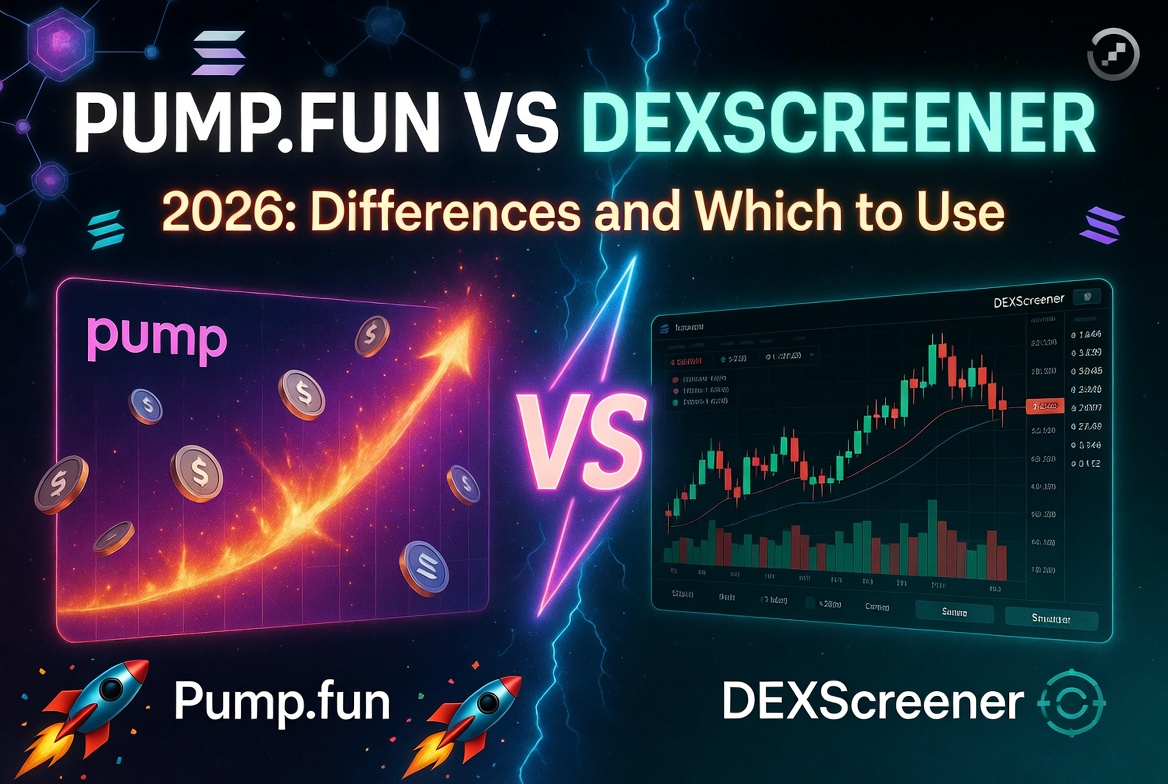
Pump.fun vs DEXScreener 2026: Differences and Which to Use
Pump.fun is a Solana memecoin launchpad that lets anyone create and trade brand-new SPL tokens within minutes, while DEXScreener is a real-time DEX analytics and charting platform that tracks price, volume, and liquidity across 80+ blockchains including Solana. The two tools serve completely different purposes — Pump.fun is where memecoins are born, DEXScreener is where traders monitor them — and in 2026 the most effective Solana memecoin traders use both together as part of the same workflow.
Read more
How to Buy Solana Memecoins Without KYC in 2026
Buying Solana memecoins without KYC means purchasing SPL tokens — including BONK, WIF, PENGU, and FARTCOIN — directly on-chain via a self-custodial wallet and a decentralized exchange (DEX), with no identity verification, no account registration, and no centralized intermediary. In 2026, the combination of Solana’s $0.00025 average transaction fees and DEX aggregators like Jupiter makes KYC-free memecoin trading faster and cheaper than any centralized exchange alternative.
Read more
Top 5 Solana Wallets for Memecoins in April 2026
A Solana memecoin wallet is a non-custodial crypto wallet that supports the Solana blockchain, enabling users to store, send, and trade SPL tokens — including high-volatility memecoins like BONK, WIF, POPCAT, and MOTHER. The best Solana wallets for memecoins combine fast transaction signing (Solana finalizes in ~400ms), built-in DEX access, and multi-chain support for bridging gains into stablecoins like USDT or USDC.
Read more
What Is Solana Blockchain? Why It Dominates Memecoins in 2026
Solana is a high-speed, low-fee blockchain platform that processes thousands of transactions per second using its unique Proof of History (PoH) consensus mechanism, making it…
What Are Memecoins? The Complete Guide for 2026
Memecoins are a category of cryptocurrency inspired by internet memes, viral culture, and community humor, driven by social momentum rather than technical fundamentals or corporate…