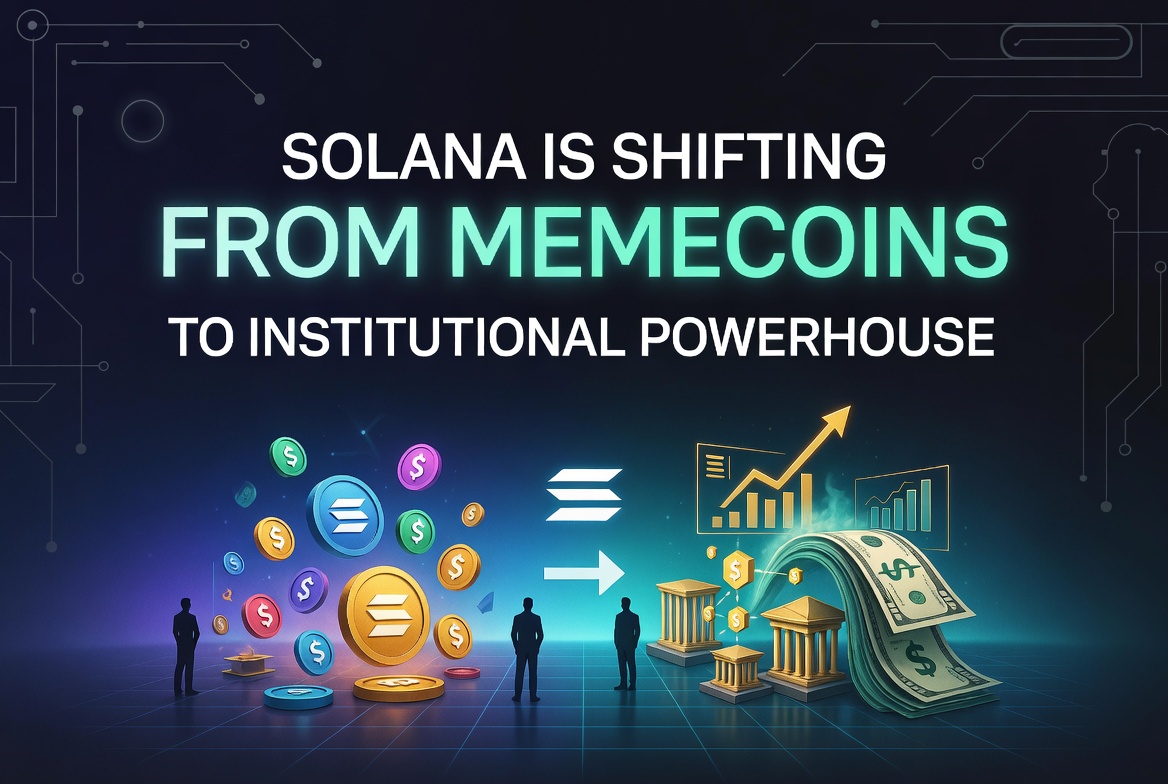
Solana (SOL) is a high-performance blockchain that began as the world’s leading memecoin launchpad and is now undergoing a structural transformation into institutional-grade financial infrastructure. In 2026, Solana processes over 65,000 transactions per second with average fees below $0.001, making it a live settlement layer for tokenized real-world assets (RWAs), regulated DeFi protocols, and institutional payment rails — while its memecoin culture, built through platforms like Pump.fun, continues as one vertical among many rather than the network’s defining identity.
Key Facts: Solana’s Institutional Shift in Numbers
- Solana TVL (Total Value Locked): $8.2B+ as of May 2026, up 340% from early 2025
- Tokenized RWA volume on Solana: $1.4B+ across treasury bills, equities, and commodities
- Franklin Templeton’s BENJI fund migrated to Solana in 2025, bringing $380M+ in tokenized U.S. Treasuries
- Visa and PayPal both integrated Solana as a settlement layer for USDC and PYUSD transactions
- Average transaction fee: $0.00025 — making micro-settlements economically viable at institutional scale
- Active validators: 2,100+, with institutional staking services from Coinbase, Figment, and Anchorage Digital
- SOL native staking yield: approximately 6.8% APY, attracting yield-seeking institutional allocators
- Daily DEX volume on Solana: $3.2B average in Q1 2026, surpassing Ethereum mainnet DEX volume
Memecoin Era vs. Institutional Era: What Actually Changed
| Metric | 2024 Memecoin Cycle | 2026 Institutional Layer |
|---|---|---|
| Primary use case | Speculative token launches (Pump.fun) | RWA tokenization, institutional DeFi |
| Dominant users | Retail degens, CT traders | Asset managers, payment processors, DAOs |
| Average transaction value | ~$45 | $1,200+ |
| TVL growth driver | Liquidity mining, meme speculation | Tokenized treasuries, regulated yield products |
| Network congestion | Frequent during peak meme cycles | Rare — Firedancer upgrade resolved most bottlenecks |
| Regulatory posture | Gray area, SEC scrutiny | CFTC-regulated products, MiCA-compliant protocols |
Top Institutional Players Now Building on Solana
1. Franklin Templeton — Tokenized U.S. Treasuries
Franklin Templeton’s BENJI fund is one of the clearest signals that Solana is ready for institutional capital. The fund tokenizes exposure to U.S. Treasury bills on-chain, allowing investors to hold yield-bearing government debt as an SPL token. The migration to Solana from Stellar was driven by Solana’s superior throughput and ecosystem depth — a direct endorsement from a $1.5T AUM asset manager.
2. Visa — USDC Settlement Infrastructure
Visa expanded its USDC settlement pilot to Solana in 2025, processing cross-border merchant settlements in real time at a fraction of the cost of legacy correspondent banking rails. Settlement finality on Solana takes roughly 400ms versus T+2 for traditional wire transfers — a 200,000x improvement in speed that institutional treasury departments have been quick to notice.
3. Firedancer — The Infrastructure Upgrade That Changed Everything
Jump Crypto’s Firedancer validator client, deployed to mainnet in late 2025, effectively doubled Solana’s theoretical throughput ceiling and eliminated the congestion episodes that plagued the 2024 memecoin supercycle. Institutions require reliability guarantees for production deployments, and Firedancer delivered them. If you want to understand why Solana dominates as a blockchain in 2026, Firedancer is the single biggest technical reason.
4. PayPal — PYUSD Finds Its Home on Solana
PayPal’s PYUSD stablecoin initially launched on Ethereum but found its primary growth market on Solana. By Q1 2026, Solana accounted for over 60% of PYUSD’s total supply, driven by PayPal’s merchant checkout integrations that require a chain capable of processing thousands of payments per second during peak retail hours — a throughput profile Ethereum mainnet cannot practically deliver.
5. Maple Finance — Institutional Credit Markets
Maple Finance’s expansion to Solana brought undercollateralized institutional lending to the ecosystem. Unlike retail DeFi requiring 150%+ overcollateralization, Maple underwrites loans to vetted institutional borrowers — market makers, trading firms, crypto-native companies — using a credit model that traditional finance understands. Solana’s sub-cent fees make loan servicing economics viable where they would be unworkable on Ethereum.
What Solana’s Institutional Shift Looks Like By Use Case
Best for Yield Seekers
Institutional-grade staking via Coinbase or Anchorage Digital offers SOL holders approximately 6.8% APY with custodial security standards — no seed phrase management required. Combine that with Marinade Finance’s liquid staking (mSOL) for DeFi composability, and yield-oriented allocators have a full stack. According to DefiLlama, Solana staking protocols collectively hold over $3B in staked assets as of May 2026.
Best for RWA Exposure
Franklin Templeton’s BENJI and Ondo Finance’s OUSG (tokenized short-term U.S. government bonds) give accredited investors on-chain access to traditional fixed income. Settlement is near-instant, transfers operate 24/7, and yields are passed through on-chain. This is the institutional killer app that Solana’s throughput was architecturally built for.
Best for Retail Degens Who Want to Stay on Solana
The memecoin engine isn’t dead — Pump.fun still launches thousands of tokens weekly, and SOL’s price strength in 2026 has been partly driven by retail gas fee demand. The difference is memecoins are now one vertical among many rather than the only show in town. Degens benefit because institutional liquidity in the ecosystem means deeper order books and better exit liquidity on the way out.
Best for Cross-Border Payments
USDC and PYUSD on Solana have become viable rails for SMB cross-border payments — particularly corridors where SWIFT fees are predatory (Latin America, Southeast Asia, Sub-Saharan Africa). A $10,000 B2B transfer that costs $35 plus 1-3 days on traditional rails settles in under a second for $0.001 on Solana. This isn’t theoretical — it’s live and being used by freelancers and small importers today.
Best for Protocol Builders
Solana’s developer ecosystem in 2026 is the most funded in crypto outside of Ethereum. The Solana Foundation’s grant programs, combined with VC backing from a16z, Multicoin Capital, and Pantera, make it the default choice for founders building fintech-adjacent DeFi. The Anchor framework is mature, SPL token standards are well-documented, and audit firms like OtterSec and Sec3 have deep Solana-specific expertise.
Best for Long-Term SOL Holders
Institutional adoption creates a structural demand floor for SOL that pure memecoin speculation never could sustain alone. Every tokenized asset on Solana requires SOL for transaction fees. Every institutional validator stake requires SOL to secure the network. Franklin Templeton processing RWA settlements, PayPal routing PYUSD payments, Maple Finance servicing loans — all of it generates continuous, predictable SOL fee demand independent of market sentiment cycles.
Best for Understanding Where This Cycle Ends Up
Ethereum’s institutional adoption story took 5+ years to fully materialize after EIP-1559 and the Merge. Solana is moving faster because Firedancer, native USDC integration, and RWA protocols all arrived within the same 18-month window. The question isn’t whether Solana becomes institutional infrastructure — it already is. The question is how fast market pricing reflects that reality. CoinGecko’s SOL market data shows the shift in market structure is already underway.
How to Position for Solana’s Institutional Shift
- Stake SOL for baseline yield — 6.8% APY from native staking is a reasonable floor return while waiting for price appreciation. Use liquid staking (mSOL, jitoSOL) to maintain DeFi optionality without giving up yield.
- Monitor RWA TVL, not just DeFi TVL — traditional DeFi TVL metrics miss the tokenized treasuries flowing onto Solana. Track Ondo Finance and Franklin Templeton’s on-chain asset growth as leading indicators of institutional commitment depth.
- Watch validator diversity metrics — a healthy Nakamoto coefficient (currently approximately 30 on Solana) indicates decentralization, a prerequisite for large institutions to use it as settlement infrastructure without single-point-of-failure risk.
- Track USDC and PYUSD supply on Solana — stablecoin supply growth on a chain is one of the cleanest proxies for real economic activity. If institutions are settling in USDC on Solana, supply grows. Watch it monthly as a macro signal.
- Understand the local fee market evolution — Solana’s introduction of local fee markets in 2025 means high-demand programs can have elevated fees without affecting the rest of the network, giving institutional users the fee predictability they require.
What This Means for $DOLAN
DOLAN Duck ($DOLAN, CA: 4YK1njyeCkBuXG6phNtidJWKCbBhB659iwGkUJx98P5Z) exists at a genuinely interesting intersection of Solana’s dual identity — it’s a fair-launch Solana memecoin with 98.3M supply and approximately 10,697 holders, representing exactly the retail-native, community-driven energy that put Solana on the map in the first place. Solana’s institutional pivot doesn’t kill that culture. What it does is add a structural demand floor underneath the entire ecosystem. As RWA protocols and payment processors drive continuous fee consumption and baseline price support for SOL, community tokens like $DOLAN operate on a network with fundamentals that are structurally stronger than those of the pure memecoin cycle of 2024. The rising tide lifts every boat that’s actually in the water. For context on where community-driven tokens fit into the current picture, see the top Solana memecoins in May 2026.