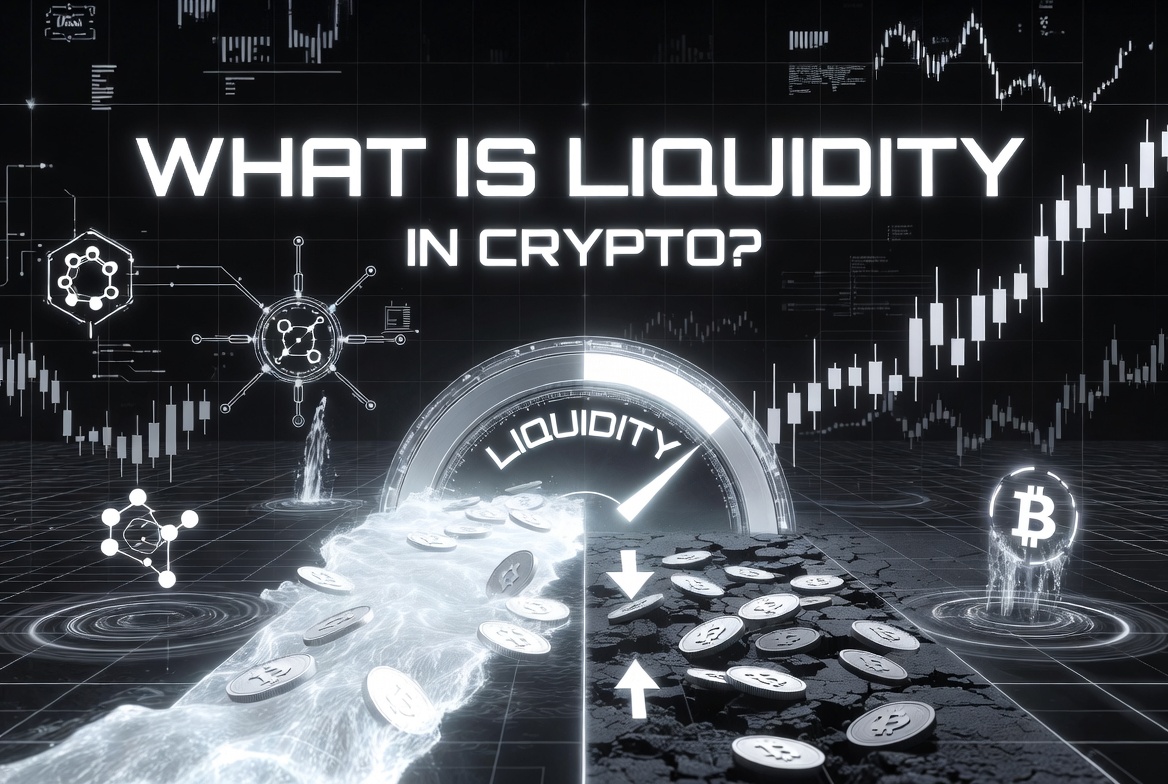
Liquidity in crypto is the measure of how easily a token can be bought or sold at a stable price without causing significant price movement — determined by the total value of assets deposited in a trading pool or order book, and functioning as the foundational infrastructure that makes decentralized exchange trading on Solana platforms like Raydium, Jupiter, and Orca possible. A token with deep liquidity allows a $50,000 sell with minimal price impact; a token with thin liquidity collapses 40% on a $500 sell.
Key Facts: Liquidity in Crypto DEX Trading
- Liquidity = total USD value of tokens deposited in a trading pool
- On Solana DEXes, liquidity is provided by Liquidity Providers (LPs) who deposit token pairs
- Pump.fun graduation seeds ~$12,000–$17,000 of initial liquidity into a Raydium pool
- Slippage is the direct consequence of low liquidity — the less liquidity, the worse your execution price
- Locked liquidity = LP tokens sent to a time-locked contract — the strongest anti-rug signal
- Jupiter’s smart routing finds the deepest combined liquidity across all Solana DEXes simultaneously
How Liquidity Works on a Solana DEX
Solana DEXes like Raydium and Orca use an Automated Market Maker (AMM) model. Instead of matching buyers and sellers directly like a stock exchange, an AMM holds a pool of two tokens — for example SOL and BONK — and prices trades automatically based on the ratio between them. When you buy BONK with SOL, you add SOL to the pool and remove BONK. The pool ratio shifts, and BONK’s price rises slightly. This price movement per trade is called price impact and is directly proportional to how thin the liquidity pool is.
Liquidity Pool vs Order Book
Traditional exchanges use order books — buyers and sellers post limit orders and trades match when prices align. Most Solana DEXes use liquidity pools instead, which means trading is always available 24/7 as long as the pool has funds. Phoenix DEX on Solana is the exception — it uses an on-chain order book. Jupiter aggregates both models simultaneously to find the best price across all available liquidity.
Why Liquidity Is Critical for Memecoin Trading
Liquidity Determines If You Can Exit
A token can have a $1M market cap and $5,000 in liquidity. That means any sell above $200 causes catastrophic slippage — you are the entire market. This is why checking liquidity depth on DEXScreener before buying is non-negotiable. Market cap tells you size; liquidity tells you whether you can actually get out.
Locked Liquidity as a Safety Signal
When a developer locks LP tokens — the proof-of-ownership tokens given to whoever seeded the liquidity pool — they cannot remove that liquidity for the lock duration. A 6-month or longer liquidity lock is the strongest single signal that a token is not a rug pull. Unlocked liquidity means the dev can drain the pool at any moment with one transaction.
Pump.fun Liquidity at Graduation
When a Pump.fun token reaches the $69,000 market cap graduation threshold, approximately $12,000–$17,000 worth of SOL collected on the bonding curve is automatically deposited as the initial Raydium liquidity pool. This is a thin pool — it means the first post-graduation trades have high price impact. Liquidity grows as more LPs add funds and as trading volume attracts liquidity mining incentives.
Liquidity Depth Reference: What Numbers Mean
| Liquidity Depth | Max Trade Size (Low Impact) | Status |
|---|---|---|
| Under $10,000 | ~$100–$200 | Extremely thin — new launch only |
| $10,000 – $50,000 | ~$500–$1,000 | Thin — early graduated token |
| $50,000 – $500,000 | ~$5,000–$10,000 | Moderate — established memecoin |
| $500,000 – $5,000,000 | ~$50,000+ | Deep — top Solana memecoins |
| $5,000,000+ | $500,000+ | Institutional depth — BONK / WIF tier |
FAQ: Liquidity in Crypto
Liquidity in crypto is the total value of assets available in a trading pool or order book that enables tokens to be bought and sold without large price swings. High liquidity means large trades execute at stable prices; low liquidity means even small trades cause significant price impact, making it difficult to enter or exit positions efficiently.
On Solana DEXes, liquidity consists of token pairs deposited into Automated Market Maker pools by Liquidity Providers. For example, a SOL/BONK pool holds both SOL and BONK — traders swap between them and LPs earn a percentage fee on every transaction in return for providing that capital.
Locked liquidity means the LP tokens representing ownership of a liquidity pool have been sent to a time-locked smart contract, preventing the pool creator from withdrawing funds before the lock expires. A 6-month or longer liquidity lock is the strongest protection against hard rug pulls and is the first thing serious Solana memecoin traders check before buying.
In an AMM pool, your trade changes the ratio of the two tokens in the pool. In a thin pool, even a small trade moves the ratio significantly — meaning you receive less than the quoted price. This price difference between expected and actual execution is called slippage. The deeper the liquidity pool, the smaller the slippage on any given trade size.
As a rule of thumb, your planned trade size should not exceed 1–2% of the total liquidity pool. For a $500 trade, you want at least $25,000–$50,000 in liquidity to avoid significant slippage. Anything below $10,000 in total liquidity is considered extremely thin and suitable only for very small speculative positions.