Wormhole is a cross-chain messaging protocol that lets assets and data move between Solana and other blockchains. Bridging does not physically move a token — the original is locked or burned on the source chain and a representation is minted on the destination, with a network of guardians attesting that the first step happened. That attestation layer is the entire trust model and the entire risk: a bridged token is worth what the bridge is worth, which is a different proposition from holding a native asset. Wormhole has also been used as infrastructure beyond asset transfers, including by oracle networks delivering price data.
Read moreBlockchain
What Is Raydium? Solana’s Biggest AMM Explained in 2026
Raydium is the largest automated market maker on Solana by total value locked, holding somewhere between $1.5B and $2.2B through 2026 and processing tens of billions in quarterly volume. It runs several distinct pool types rather than one: concentrated liquidity pools for deep pairs, constant-product pools for everything else including most memecoins, and LaunchLab, its own bonding-curve launch venue added in 2025. For a memecoin trader the practical relevance is that a large share of Solana pairs live in Raydium pools, and which pool type a token sits in determines how its price behaves under pressure.
Read more
What Is Pyth Network? Price Oracles on Solana Explained
Pyth Network is an oracle that brings real-world prices onto Solana and other blockchains, sourced directly from over 120 publishers including trading firms like Jane Street, Cumberland and Wintermute alongside venues such as CBOE. It uses a pull model: prices are aggregated continuously on Pythnet, its own appchain, and an application requests the latest update on-chain at the moment it needs one, rather than a feed being pushed constantly whether anyone reads it. That design is why oracle costs scale with usage instead of with time, and it is the main structural difference from earlier oracle networks.
Read more
What Is Metaplex? NFTs and Token Metadata on Solana 2026
Metaplex is the protocol that supplies Solana’s metadata layer — the programs that attach a name, symbol, image and creator information to a token or NFT. This matters far beyond NFTs, because the SPL Token Program itself stores none of that: a mint records supply, decimals and authorities, and nothing else. Every memecoin ticker and logo you have ever seen in a wallet comes from a Metaplex metadata account sitting alongside the mint. That separation is also why token names can be changed after launch, and why the ticker is not an identifier.
Read more
What Is Helius? Solana RPC Nodes and Infrastructure 2026
Helius is a Solana infrastructure provider whose main product is RPC access — the endpoints that wallets, DEX interfaces and bots use to read chain state and submit transactions. An RPC node is not a validator: it does not vote or produce blocks, it maintains a copy of the chain and answers queries about it. Every action you take in a wallet passes through one, and the quality of that endpoint determines whether your transaction reaches a leader in time or quietly dies in a queue. Most traders never think about RPC until a launch, when suddenly it is the only thing that matters.
Read more
Token-2022 Explained: What Changed for Solana SPL Tokens
Token-2022 is a separate Solana token program that keeps the original SPL interface intact while adding optional features called token extensions — transfer fees, confidential balances, freeze-by-default states, hooks that run custom code on every transfer, and a permanent delegate that can move tokens without the holder’s signature. It does not replace the original SPL Token Program; both run side by side at different program addresses, and a mint belongs to exactly one of them forever. For traders the practical consequence is blunt: two tokens that look identical in a wallet can behave completely differently on transfer.
Read more
Solscan vs Solana Explorer vs SolanaFM: Which One to Use
Solscan, the official Solana Explorer and SolanaFM all read the same chain and present it differently, which is why experienced users keep more than one open. Solscan is the best general-purpose option for token checks and holder data. Solana Explorer is the plainest reflection of raw chain state, useful precisely because it interprets nothing. SolanaFM decodes complex transactions and compressed NFTs better than either, though it has been less actively developed since Jupiter acquired it in September 2024. None is authoritative — they are interfaces over the same ledger, and when they disagree it is a display difference, not a chain difference.
Read more
What Is Rent on Solana? Why Every Account Locks Up SOL
Rent on Solana is a refundable SOL deposit that every account must hold to stay in memory, sized by how many bytes that account occupies. It is not a fee and nobody keeps it: the deposit sits locked while the account exists and returns in full the moment the account is closed. The name is a leftover from an earlier design where accounts genuinely paid rent over time and could be deleted when they ran dry. That version is gone — new accounts must be rent-exempt from creation — but the deposit remains, and it is the reason a wallet that has traded fifty memecoins has SOL it cannot see.
Read more
Solana Programs vs Ethereum Smart Contracts: Key Differences
Solana programs and Ethereum smart contracts do the same job through opposite architectures: a Solana program is stateless executable code that owns no data, while an Ethereum contract bundles code and storage into a single entity. Every piece of state a Solana program touches lives in a separate account passed in explicitly with each transaction. That one design decision cascades into everything else — it is why Solana can execute transactions in parallel, why programs are upgradeable by default, and why a Solana “contract audit” is asking a different set of questions than an Ethereum one.
Read more
Solana Keypair Explained: Public and Private Keys in 2026
A Solana keypair is a single Ed25519 private key plus the public key mathematically derived from it, and that public key — encoded in base58 — is your wallet address. Nothing else defines ownership on Solana: there is no account registration, no username, and no record anywhere linking you to the address beyond the fact that only your private key can produce a valid signature for it. The address exists the moment the key exists, whether or not it has ever received a lamport. Understanding this one relationship clears up most of the confusion around seed phrases, multiple accounts and why a leaked key is unrecoverable.
Read more
Solana Devnet vs Testnet vs Mainnet: What’s the Difference
Solana devnet, testnet and mainnet beta are three completely separate networks running the same software with different purposes and no shared state. Mainnet beta is the real chain where SOL has value. Devnet is a sandbox where developers get free tokens on request and nothing they do has consequences. Testnet is where validator client releases get stress-tested before touching real money, which means it breaks on purpose. An address can exist on all three at once holding different balances, and a token that looks legitimate on devnet is worth exactly nothing.
Read more
What Are Compute Units? Solana’s Compute Budget Explained
Compute units are Solana’s metering system for computational work — the chain’s equivalent of Ethereum gas, but priced and capped very differently. Every instruction a transaction executes consumes compute units from a budget, and if the budget runs out mid-execution the transaction fails and still costs a fee. Unlike gas, compute units are not what you pay with: they are a resource limit you request, and the priority fee you set is multiplied by that requested amount. Getting the two numbers wrong in either direction is why swaps fail during busy minutes.
Read more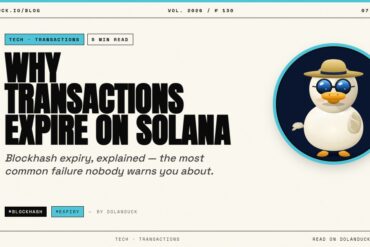
Why Solana Transactions Expire: Blockhashes Explained 2026
A Solana transaction expires because every transaction carries a recent blockhash that stays valid for only 150 blocks — roughly a minute of real time. Once the network moves past that window the transaction becomes permanently invalid and cannot be processed, no matter how well-formed it is. This is deliberate: Solana has no mempool holding pending transactions indefinitely, so the blockhash acts as both a timestamp and a deduplication key. “Transaction expired” and “blockhash not found” are the same event described from different angles, and they are the single most common reason a memecoin buy silently does nothing.
Read more
What Happens If You Send Tokens to the Wrong Solana Address
Sending tokens to the wrong Solana address is final in almost every case. There is no reversal mechanism, no support desk with authority over the ledger, and no way to force a transfer back — the network executed a valid instruction signed by your key, and that is the end of it. Whether anything can be done depends entirely on who or what controls the destination: a friend’s wallet is a conversation, an exchange deposit address is a support ticket with poor odds, and a randomly mistyped address is almost certainly permanent.
Read more
How to Revoke Token Approvals and Delegates on Solana 2026
Revoking a token approval on Solana means removing a delegate — an address you previously authorised to move tokens from one of your token accounts. Solana’s model differs from Ethereum’s: instead of a blanket allowance for a contract across your whole wallet, each token account can name one delegate with an approved amount, and revoking clears that account’s delegate specifically. Checking and revoking is worth doing periodically, but it is important to understand the limit: on Solana the more common way wallets get emptied does not involve delegates at all.
Read more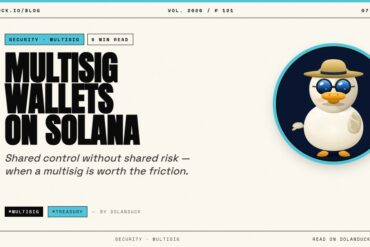
Multisig Wallets on Solana: How They Work and Who Needs One
A multisig wallet requires signatures from several separate keys before a transaction executes, so no single compromised key or single person can move the funds. On Solana this is implemented as a program-controlled account rather than a special kind of keypair: the assets sit at an address that has no private key at all, and a program releases them only when the required number of approvals has been collected. That distinction matters because it means a Solana multisig is a piece of software you are trusting, not a cryptographic primitive.
Read more
What Is Wrapped Solana (wSOL)? How Wrapping SOL Works 2026
Wrapped Solana (wSOL) is native SOL packaged as an SPL token so that on-chain programs expecting a standard token account can handle it. It lives at one hardcoded mint address — So11111111111111111111111111111111111111112 — carries the same nine decimals as SOL, and redeems 1:1 forever. There is no oracle, no peg to defend, and no bridge involved: wrapping moves your SOL into a token account where the Token Program reports it as a token balance instead of a wallet balance. Most Solana traders hold wSOL for a few seconds every time they swap and never notice it happened.
Read more
What Is MEV on Solana? Sandwich Attacks Fully Explained
MEV on Solana is the value a block producer or a bot extracts by choosing what order transactions execute in. Solana has no public mempool, so the Ethereum-style scramble over pending transactions does not exist — instead MEV flows through private transaction feeds shared with block producers, which makes it less visible without making it less real. Sandwich attacks, where a bot buys immediately before your swap and sells immediately after, extracted somewhere between $370M and $500M from Solana users over a recent sixteen-month period, with wide multi-slot attacks accounting for around 93% of that activity.
Read more
Firedancer Solana: What the New Validator Client Changes
Firedancer is an independent Solana validator client written from scratch in C by Jump Crypto, and it is the first serious answer to a problem the network carried for years: almost every validator ran the same software. It went live on mainnet at Breakpoint 2025 in Abu Dhabi in December 2025, and as of August 2026 the full client runs roughly 14% of staked SOL, with a further ~26% on the Frankendancer hybrid. That matters less as a speed story than as an insurance policy — a bug in one codebase can no longer stall the entire chain, which is exactly the failure mode that produced Solana’s outage history.
Read more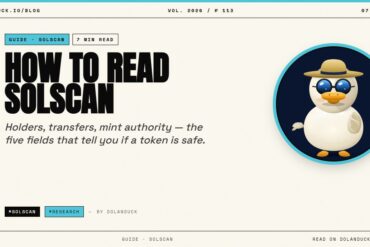
How to Read Solscan: A Beginner’s Guide to the Explorer
Solscan is a block explorer — a searchable window onto Solana’s ledger showing every account, transaction, token and validator. For a memecoin trader it is the one source that cannot be marketed at: a mint page states supply, authorities, holder distribution and creation date as facts, regardless of what any website or Telegram channel claims. Learning to read five specific fields turns it from an intimidating wall of hashes into a sixty-second verification routine that filters out most of what goes wrong.
Read more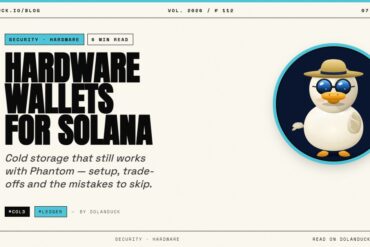
Hardware Wallets and Solana: What Actually Works in 2026
A hardware wallet keeps your private key inside a dedicated device so that signing happens on-chip and the key never touches an internet-connected computer. For Solana in 2026 the main options — Ledger, Trezor, Keystone and Tangem — all support SOL and SPL tokens, though they differ significantly in how they connect and what software you pair them with. The protection they offer is real and narrow: they defend the key, not the decision. A hardware wallet will sign a wallet-draining transaction just as faithfully as a legitimate one if you approve it.
Read more
Dust Attacks Explained: Why Random Tokens Appear in Wallets
A dust attack is an unsolicited transfer of a tiny amount to a large number of wallets, sent either to track how those wallets move funds or to plant something the owner will interact with. On Solana the second motive dominates: the “dust” is usually a worthless token with an enticing name and an image pointing at a phishing site, delivered to thousands of addresses for a few dollars in fees. The token itself cannot harm you sitting in your wallet. Everything dangerous about it starts the moment you try to do something with it.
Read more
Custodial vs Self-Custodial Wallets: Where Your Coins Live
In a custodial wallet, someone else holds the private keys and your balance is a database entry representing a claim against them. In a self-custodial wallet you hold the keys, and your balance is an on-chain fact that nobody can alter. The difference is not a preference setting — it changes who can freeze your funds, who can lose them, and whether “your” tokens exist on the blockchain at all under an address you control. For most Solana memecoins the question resolves itself, because they never list on custodial platforms in the first place.
Read more
What Is a Crypto Drainer? How Wallet-Draining Sites Work
A crypto drainer is packaged software that empties a wallet the moment its owner signs one prepared transaction. It is sold or rented as a service — the operator supplies the code and the infrastructure, an affiliate supplies the traffic, and they split the proceeds. Nothing about it exploits a bug in Solana or in your wallet: the transaction is valid, the signature is yours, and the transfer is final. Losses from this category ran to roughly $494 million across more than 332,000 wallets in 2024, fell to about $83.85 million across 106,106 wallets in 2025, then signature phishing spiked 207% in January 2026.
Read more
Who Founded Solana? The Anatoly Yakovenko Story in Full
Solana was founded by Anatoly Yakovenko, a former Qualcomm engineer who published the Proof of History whitepaper in November 2017 after more than a decade building wireless network systems. He was joined by Raj Gokal as co-founder and COO, plus two ex-Qualcomm colleagues — Greg Fitzgerald and Stephen Akridge — who turned the paper into working code within months. The project launched under the name Loom, was renamed after Solana Beach in California to avoid confusion with an Ethereum project, and reached mainnet beta in March 2020. Six years later the chain it produced sits at rank #7 with a market cap near $42.4B and runs the largest memecoin economy in crypto.
Read more
Burner Wallets on Solana: What They Are and When to Use One
A burner wallet is a separate keypair you use for risky activity, funded with only what you are willing to lose entirely. It exists because signing a malicious transaction can empty everything an address holds in one block, and the only reliable defence is not having much in the address that signs. On Solana a burner costs nothing to create and takes seconds, which makes the practice unusually cheap — the discipline is not in making one but in keeping it genuinely isolated from everything else you own.
Read more
Address Poisoning on Solana: How the Scam Actually Works
Address poisoning is a scam that plants an address resembling one you already use into your transaction history, betting that next time you send funds you will copy it from that history instead of from the real source. Attackers generate vanity addresses matching the first and last few characters of a genuine address, send a zero-value or dust transaction to insert it into your feed, and wait. It requires no exploit, no signature and no access to your wallet — only the very common habit of copying an address from a recent transaction. Two individuals lost $12.25 million and $50 million to exactly this in December 2025 and January 2026.
Read more
Solana vs Sui in 2026: Speed, Fees, and Memecoin Reality
Solana vs Sui is a comparison of two parallel-execution Layer-1 blockchains that took opposite paths through 2026: Solana, the #7 asset at ~$46B market cap, still runs the largest memecoin economy in crypto despite a 62% DEX volume drawdown, while Sui — the Move-language chain built by Mysten Labs — saw its TVL shrink from a $2B peak to roughly $440M and its token fall about 85% from $4.40 to a $0.63 February wick. Both chains promise sub-second finality and near-zero fees; only one still has the liquidity to back the promise.
Read more
Solana vs Base in 2026: Which Chain Wins for Memecoins?
Solana vs Base is the defining Layer-1 versus Layer-2 rivalry of 2026 memecoin trading: Solana is a standalone blockchain with ~$0.00025 fees and the deepest memecoin liquidity in crypto, while Base is Coinbase’s Ethereum Layer-2 with roughly $4.5B in TVL — the largest of any L2 — and a retail funnel flowing straight from the Coinbase app. Both chains print memecoins daily, both lost attention to Robinhood Chain’s July launch, and both answer the same trader question differently: do you want raw speed and degen culture, or Ethereum settlement and a CEX on-ramp?
Read more
What Is Robinhood Chain? Robinhood’s New L2 Explained 2026
Robinhood Chain is a permissionless Ethereum Layer-2 blockchain launched by Robinhood Markets on July 1, 2026, built on Arbitrum Orbit with ~100-millisecond block times and ETH as its gas token. Designed as infrastructure for tokenized stocks and real-world assets, the chain instead found its first product-market fit in memecoins: within two weeks it crossed $312M in TVL, briefly matched Coinbase’s Base in daily DEX volume, and produced CASHCAT — a cat token that touched a $200M market cap before Robinhood’s tokenized-stock volumes had even registered.
Read more