Is Solana better than Ethereum? It depends on what “better” measures: Solana wins on raw performance — ~400ms finality, $0.00025 fees, and the highest retail DEX activity in crypto — while Ethereum wins on DeFi depth ($48B+ TVL), institutional adoption, decentralization record, and a layer-2 ecosystem that absorbs its scaling problem. In 2026 both chains sit deep in drawdowns, which strips the question to fundamentals rather than price momentum. The honest frame is two different products: Ethereum is crypto’s settlement bank, Solana is its consumer exchange floor — and “which is better” resolves into “better for what.”
Read more
How to Stake Solana in 2026: Earn ~7% APY Paid Out in SOL
How to stake Solana: delegate your SOL to a validator directly from a self-custody wallet — a five-minute process with no minimum amount — and the network pays you roughly 7% APY in additional SOL, credited automatically every epoch (~2-3 days). Staking is Solana’s native passive income: rewards come from protocol emissions and fees, they compound without any action from you, and your SOL never leaves an account you control. It is also the only mechanism that fully protects a long-term holder from inflation dilution — staked positions grow their share of the network while idle ones shrink.
Read more
How to Sell Solana in 2026: CEX, DEX and Short Positions
How to sell Solana depends on where the exit leads: selling to fiat runs through a centralized exchange (deposit SOL, sell, withdraw cash), staying in crypto is a one-click DEX swap to a stablecoin through Jupiter, and betting on further downside means shorting via perpetual futures rather than selling at all. All three routes settle in minutes in 2026 — the friction points are elsewhere: exchange holds that block fresh deposits, staked SOL that needs 2-3 days to unlock, and the tax event every disposal triggers. Here is each route with its real costs.
Read more
Where to Buy Solana Meme Coins in 2026: Top 5 Platforms
Where to buy Solana meme coins depends on the token’s age: brand-new launches trade on bonding-curve launchpads like Pump.fun, graduated tokens trade through DEX aggregators like Jupiter or directly on Raydium pools, and only a handful of majors (BONK, WIF, PENGU) ever reach centralized exchanges. In 2026 the practical default is a self-custody wallet plus Jupiter — it routes your order across every Solana DEX for the best price and covers 99% of tradeable memecoins. Total setup time from nothing to first trade: about five minutes and a few dollars in SOL.
Read more
Is Solana Deflationary? SOL Inflation Explained for 2026
Is Solana deflationary? No — Solana is an inflationary network by design, emitting new SOL as staking rewards at roughly 3.6% annually in 2026, on a fixed disinflation schedule that started at 8% in 2021, declines 15% per year, and settles at a 1.5% terminal rate. A burn mechanism exists — 50% of every base transaction fee is destroyed — but at current activity levels it removes far less SOL than emissions add. The practical consequence matters more than the label: stakers earning ~7% outrun inflation and gain network share, while idle holders are diluted every epoch.
Read more
Is Solana Dead in 2026? What Network Data Actually Shows
Is Solana dead? No — Solana is a layer-1 blockchain that still settles millions of transactions per day, leads all chains in DEX transaction count, and has run without a major outage since early 2024, even though SOL’s price sits near $81 in July 2026, roughly 72% below its all-time high. “Dead” is a claim about usage, not price, and the two have rarely disagreed this loudly: revenue-generating activity continues while the token trades at 2023-era levels. This guide separates the network data from the doom takes, and flags the one metric that actually deserves concern.
Read more
How to Buy Solana in Canada in 2026: Apps, Fees and TFSA
How to buy Solana in Canada in 2026 takes three steps: open an account on a CIRO-regulated platform (Kraken, Wealthsimple Crypto, or Newton), fund it in CAD via Interac e-Transfer, and place a SOL order — most platforms accept purchases from $10. Canada also offers a route no US buyer has in the same form: regulators have approved spot Solana ETFs, meaning Canadians can hold SOL exposure inside a TFSA or RRSP tax-sheltered account. Which route wins depends on whether you want tax shelter or actual on-chain tokens you can stake, transfer, and trade against memecoins.
Read more
Can You Mine Solana? No — Here’s How to Earn SOL in 2026
Can you mine Solana? No — Solana is a proof-of-stake blockchain, so there is no mining, no GPU rigs, and no hash power involved anywhere in the network. New SOL enters circulation as staking rewards paid to validators and the holders who delegate to them, currently yielding around 7% APY. Anything advertising “Solana mining” — cloud contracts, mining apps, browser miners — is either mislabeled staking or an outright scam. The real ways to earn SOL in 2026 are staking, liquid staking, running a validator, and providing DeFi liquidity, each with different capital and risk profiles.
Read more
Will Solana Reach $1,000? Realistic SOL Targets to 2030
Will Solana reach $1,000? From its July 2026 price near $81, SOL would need roughly a 12x — a move that implies a market cap around $580 billion, about half of Bitcoin’s entire current valuation. That is not impossible on a 2030 horizon, but it is a different claim than “SOL recovers”: reclaiming the $294 all-time high needs only a 3.6x, while $500 needs a 6x. Institutional forecasts frame the honest range — VanEck’s 2030 scenarios run from $9.81 (bear) through $335 (base) to $3,211 (bull), and Standard Chartered has floated $2,000. This guide runs the market-cap math on every popular target so you can judge which multiples are cycle-realistic and which require a new financial system.
Read more
How to Create a Meme Coin in 2026: Complete Launch Guide
How to create a meme coin in 2026 comes down to five steps: define a meme concept and ticker, choose a blockchain, deploy through a launchpad (often for under $5), configure liquidity and safety settings, and build the community that gives the token any value at all. A meme coin is a community-driven cryptocurrency whose price is powered by attention rather than utility — and the tooling has become so cheap that platforms like Pump.fun have processed over 11.9 million token launches since 2024. The technical launch is the easy 1%; the other 99% is everything this guide covers after the deploy button.
Read more
How to Create a Meme Coin on Solana in 2026: Step Guide
How to create a meme coin on Solana in 2026: the fastest route is a launchpad like Pump.fun, where deploying costs nothing upfront and takes under five minutes — upload an image, set a name and ticker, and the platform mints your SPL token on an automated bonding curve. The manual route — creating the token yourself and opening a DEX pool — costs under $3 in network fees but requires you to handle metadata, authorities, and liquidity on your own. Solana hosts tens of thousands of token launches per day, so the deploy is trivial; standing out is the actual work, and we cover that in the complete meme coin launch guide.
Read more
Why Is Solana Going Down in 2026? Crash Reasons Explained
Why is Solana going down? SOL trades near $81 in July 2026 because four pressures hit the same chart in sequence: the Libra memecoin scandal in February that erased roughly $4 billion and gutted retail confidence, the $200M+ Drift Protocol exploit in April that drove liquidity out of Solana DeFi, continuous FTX bankruptcy estate liquidations adding steady sell pressure, and a global risk-off shift triggered by Bank of Japan tightening and record Bitcoin ETF outflows. None of these broke the network itself — fees, uptime, and transaction throughput remain normal — but together they cut SOL’s price by more than half from its May levels.
Read more
Is Solana a Good Investment in 2026? Honest SOL Breakdown
Is Solana a good investment in 2026? Solana (SOL) is a high-throughput layer-1 blockchain whose token trades near $81 in July 2026 — roughly 72% below its January 2025 all-time high of $294 — after a brutal first half driven by the Libra scandal, the Drift Protocol exploit, and relentless FTX estate selling. The network itself keeps shipping: sub-cent fees, ~400ms finality, and the deepest memecoin infrastructure in crypto. That gap between broken price and working product is exactly where the investment question lives, and the answer depends on your time horizon and how much drawdown you can stomach.
Read more
Can You Launch Memecoins on Bitcoin? Runes and Ordinals Explained
Launching memecoins on Bitcoin is technically possible in 2026 through two protocols: Runes (a fungible token standard using Bitcoin’s UTXO model, launched in April 2024 by Casey Rodarmor) and Ordinals (a system for inscribing arbitrary data onto individual satoshis, which enabled BRC-20 tokens as an early experimental fungible standard). Both demonstrate that Bitcoin’s base layer can host tokens beyond BTC — but the practical comparison with Solana’s memecoin infrastructure is stark: Bitcoin Runes transfers cost $0.50–$5+ per transaction, take 10–60 minutes to finalize, and require specialized wallets, versus Solana’s $0.00025 fees and 400ms finality that make Pump.fun’s 40,000+ daily token launches economically viable.
Read more
What Are SPL Tokens on Solana? The Complete Guide for 2026
SPL tokens (Solana Program Library tokens) are digital assets created and managed on the Solana blockchain using the Token Program — a single shared on-chain program that standardizes how all fungible tokens, non-fungible tokens, and semi-fungible tokens behave across the entire network. Unlike Ethereum’s ERC-20 standard where every token deploys its own separate smart contract, all SPL tokens share one Token Program, enabling transfers for as little as $0.00025 per transaction with ~400ms finality. In 2026, over 1.2 million unique SPL token mints exist on Solana mainnet — from USDC and PYUSD (stablecoins) to BONK and WIF (memecoins) to JUP and RAY (DeFi governance tokens) — all running on the same underlying standard. Understanding why SOL is required for every SPL token interaction is the practical foundation for working with this standard.
Read more
Memecoin Investment Risks: What Every Solana Trader Must Know
Solana memecoin investment carries five primary risk categories: rug pulls (developer abandons project after draining liquidity), liquidity manipulation (thin order books engineered to trap sellers), whale concentration (top holders controlling enough supply to single-handedly move price), technical risks (mint authority and freeze authority exploits), and behavioral risk (FOMO-driven entries at market tops that guarantee losses regardless of project quality). In 2025, an estimated $800M+ was lost across the Solana memecoin ecosystem — the vast majority from risks that were identifiable on-chain before the losses occurred. This guide maps each risk type and gives you the practical framework for investing in Solana memecoins without getting destroyed by avoidable mistakes.
Read more
How to Keep Your Solana Memecoins Safe in 2026
Keeping Solana memecoins safe in 2026 requires managing three distinct security layers simultaneously: wallet security (seed phrase storage, hardware wallet usage, and token approval management), on-chain verification (checking mint authority, freeze authority, and liquidity lock status before buying any new token), and behavioral security (phishing resistance, scam DM awareness, and transaction simulation before signing). Losses in the Solana memecoin ecosystem are almost never from blockchain-level hacks — they are from human error and social engineering that targets the wallet or the trader, not the network. Understanding how rug pulls work on Solana is the foundation of effective memecoin security.
Read more
Why Do You Need SOL to Send Memecoins on Solana?
SOL is the native gas token of the Solana blockchain and is required for every transaction — including sending memecoins (SPL tokens) — because Solana validators charge SOL fees to process and confirm each operation on the network. Beyond basic gas fees of approximately 0.000005 SOL per transfer, your wallet must also maintain enough SOL to cover “rent exemption” on token accounts (0.002039 SOL per unique token type you hold) and to fund the creation of new Associated Token Accounts (ATAs) the first time you receive any new SPL token. Understanding this three-layer SOL requirement is essential for anyone actively trading Solana memecoins without running into failed transactions.
Read more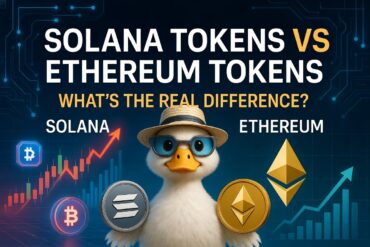
Solana Tokens vs Ethereum Tokens: What’s the Real Difference?
Solana tokens (SPL tokens) and Ethereum tokens (ERC-20, ERC-721) are both blockchain-native digital assets, but they differ fundamentally in architecture, cost, speed, and ecosystem design. Solana’s SPL token standard processes transfers in ~400ms for $0.00025 per transaction, while Ethereum’s ERC-20 standard offers broader institutional recognition and the deepest DeFi TVL in crypto at $48B+ — with average mainnet fees of $0.50 to $5+ per transaction depending on network congestion. Choosing between them in 2026 depends entirely on your use case: Solana wins on throughput and cost, Ethereum wins on liquidity depth, L2 ecosystem maturity, and brand recognition with traditional finance.
Read more
Solana Memecoin Season Summer 2026: Is a Rally Coming?
Solana memecoin season refers to cyclical periods of intense retail speculation on the Solana blockchain, characterized by surging Pump.fun launch volumes, elevated DEX activity on Jupiter and Raydium, and outsized price gains in community tokens — typically occurring when Bitcoin stabilizes above key levels and retail attention rotates from large-cap assets into high-risk, high-reward altcoins. In summer 2026, on-chain signals including rising active address counts (4.1M 7-day average), tightening funding rates on SOL perpetuals, and a BTC dominance hovering near the 52% rotation threshold all point toward conditions that historically precede a Solana memecoin rally within 4–8 weeks.
Read more
Solana Price Prediction Summer 2026: What’s Next for SOL?
Solana (SOL) is a high-throughput layer-1 blockchain trading at approximately $168 in May 2026, with summer 2026 price predictions ranging from a bearish $100 floor to a bull-case target of $200 and beyond, depending on macro conditions, ETF inflows, and on-chain activity metrics. SOL — also known as the native token of the Solana network — entered the summer cycle with 65,000+ TPS throughput, $8.2B+ TVL, and growing institutional participation from Franklin Templeton, Visa, and PayPal, creating a fundamentally different demand profile than in previous summer lulls.
Read more
Solana’s Next Chapter: From Memecoins to Institutional Money
Solana (SOL) is a high-performance blockchain that began as the world’s leading memecoin launchpad and is now undergoing a structural transformation into institutional-grade financial infrastructure. In 2026, Solana processes over 65,000 transactions per second with average fees below $0.001, making it a live settlement layer for tokenized real-world assets (RWAs), regulated DeFi protocols, and institutional payment rails — while its memecoin culture, built through platforms like Pump.fun, continues as one vertical among many rather than the network’s defining identity.
Read more
Top 5 Solana Memecoins to Watch in May 2026: Full Breakdown
Solana memecoins entering May 2026 are set up for amplified moves as Bitcoin’s confirmed $80K+ breakout drives the rotation sequence from BTC to ETH to SOL to memecoins — a pattern that has repeated in every Solana cycle since 2023. Five tickers stand out based on liquidity depth, community traction, and historical beta versus SOL price: BONK (the original Solana community airdrop token, December 2022), WIF (dogwifhat, tier-1 with $4.7B peak market cap), PNUT (Peanut the Squirrel, viral October 2024 launch with $1.6B peak), PENGU (Pudgy Penguins cross-chain brand with real-world IP), and PUMP (direct exposure to Pump.fun platform revenue). Each carries a distinct risk and return profile — knowing where each sits in the liquidity stack matters as much as picking the ticker itself.
Read more
Should You Invest in Solana Memecoins in May 2026? Risks Explained
Investing in Solana memecoins in May 2026 means operating in the highest-risk, highest-reward segment of the highest-volatility asset class in finance — where over 98% of tokens launched on Pump.fun never recover their launch-day high, SOL itself trades 68% below its January 2025 ATH of $295.9, and the few tokens that survive deliver 100x–1000x returns to early buyers. The question is not whether Solana memecoins carry risk — they carry extreme risk by design — but whether the current market structure in May 2026 offers asymmetric upside worth sizing a position around.
Read more
Solana vs TON Blockchain: Who Leads in May 2026?
Solana and TON are the two most actively developing Layer 1 blockchains in May 2026 — Solana dominates with $11.49B weekly DEX volume, a $53.5B market cap, and institutional infrastructure including Western Union’s USDPT stablecoin and 8 spot ETF products, while TON is staging a structural comeback driven by Telegram’s 950 million users, the “Make TON Great Again” roadmap, and Pavel Durov personally taking Telegram in as the network’s largest validator. They are not competing for the same market: Solana owns DeFi and memecoin trading, TON is building consumer payment rails inside a messaging app.
Read more
Why Is Solana Price Rising in May 2026? Key Drivers and Risks
Solana (SOL) is trading at $92.61 on May 9, 2026 — up from a local low near $78 in late March — driven by a convergence of institutional stablecoin adoption, record DEX volume, and improving macro sentiment, while a technically active death cross and six consecutive months of declining ETF inflows keep the bull case fragile. SOL sits 68% below its all-time high of $295.9 set in January 2025, with a $53.5B market cap and the most on-chain activity of any Layer 1 blockchain by weekly DEX volume.
Read more
What Is Liquidity in Crypto? DEX Liquidity Explained for Solana Traders
Liquidity in crypto is the measure of how easily a token can be bought or sold at a stable price without causing significant price movement — determined by the total value of assets deposited in a trading pool or order book, and functioning as the foundational infrastructure that makes decentralized exchange trading on Solana platforms like Raydium, Jupiter, and Orca possible. A token with deep liquidity allows a $50,000 sell with minimal price impact; a token with thin liquidity collapses 40% on a $500 sell.
Read more
What Is a Rug Pull in Crypto? How to Spot and Avoid Them on Solana
A rug pull is a crypto scam in which the creators of a token deliberately abandon the project and drain all liquidity after attracting investor funds — leaving holders with worthless tokens and no way to sell, named after the idiom “pulling the rug out from under someone.” On Solana, rug pulls are the most common form of memecoin fraud in 2026, enabled by the near-zero cost of token creation on Pump.fun and the speed at which new tokens attract retail buyers before any due diligence is possible.
Read more
Pump.fun vs Jupiter: Where to Trade Solana Memecoins in 2026?
The choice between Pump.fun and Jupiter for trading Solana memecoins depends entirely on the stage of the token’s lifecycle — Pump.fun is the optimal venue for buying tokens in their first minutes of existence on the bonding curve before graduation, while Jupiter is the superior execution environment for all post-graduation trading where deeper liquidity, smart order routing, and limit orders eliminate the slippage and manipulation risks inherent to early bonding curve trading. The two platforms are not competitors — they are sequential tools that cover different phases of the same memecoin trade.
Read more
What Is Jupiter Exchange? Solana’s DEX Aggregator Explained (2026)
Jupiter Exchange (jup.ag) is a decentralized exchange aggregator on the Solana blockchain that routes token swaps across all major Solana DEXes — including Raydium, Orca, Meteora, and Phoenix — to find the best execution price for any SPL token trade, processing over 80% of all Solana DEX volume in 2026 and functioning as the de facto trading layer for the entire Solana ecosystem including memecoins, stablecoins, and DeFi assets. Jupiter is not a DEX itself — it is the routing intelligence layer that sits on top of every DEX on Solana simultaneously.
Read more